Saturday, September 5, 2026

Looking Back to Look Forward: What a 14-Year-Old Video Teaches Us About Today’s Classroom Screen Time Debate

https://youtu.be/53PzQD58JP0?is=iiwdplTiwsGUgfTd 


This video was from 14 yrs ago. The debate on screen time is not new. 

Remember when educational technology meant rolling a heavy CRT television into the classroom on a tall metal cart, or logging into a desktop computer lab once a week? Fourteen years ago, digital integration in K-12 schools felt like an exciting frontier of limitless potential. A classic video from that era captures a moment of pure optimism, showcasing early digital tools and tablets entering the mainstream educational space with promises of revolutionizing how students learn.

Fast forward to today, and that starry-eyed optimism has collided with a complex reality. Schools across the country are locked in intense debates over student screen time, smartphone bans, and the cognitive toll of ubiquitous digital devices. As educators navigate policies ranging from Yondr pouches for phones to completely paper-based instructional hours, looking back at where this digital shift started offers a valuable perspective on the current crisis.


The Shift from Novelty to Saturation


Yesterday’s Vision: A decade and a half ago, screens were treated as special interactive elements designed to boost student engagement and democratize access to information.

 Today’s Reality: Devices have shifted from occasional learning supplements to constant tethers, raising urgent concerns about attention spans, digital fatigue, and student well-being.


The Current Screen Time Debate in K-12 Schools


The Push for Disconnection: Driven by mounting research on adolescent mental health and distraction, districts nationwide are implementing strict bans on personal smartphones during instructional hours.

 The Instructional Dilemma: While teachers see the benefits of removing social media distractions, many still rely on digital platforms for core curriculum, hybrid learning structures, and specialized accommodations.

 Finding the Balance: Modern classrooms are trying to redefine "meaningful tech use"—moving away from passive screen consumption toward intentional, creation-based digital literacy.


Revisiting the tech discussions of fourteen years ago reminds us that tools are only as effective as the boundaries we set around them. As teachers balance digital expectations with the cognitive needs of students today, the goal isn't to reject technology entirely, but to ensure that humans—not screens—remain at the center of the educational experience.


Wednesday, August 12, 2026

First day of school


For the first time in more than 50 years, I’m not beginning a new school year as either a student or an educator. It’s a strange feeling, and I’m not quite sure what to make of it yet.

As this new school year begins, I’m praying for a safe, successful, and rewarding first day for every student, teacher, staff member, administrator, and parent. May this year be filled with learning, growth, kindness, and countless opportunities to make a positive difference.

Wishing everyone a wonderful school year!


Tuesday, August 4, 2026

Technology Expectations

Before you hand students a device, teach them the expectations. Technology works best in the classroom when the rules are clear from day one. 
 📱 Teach students: 
✅ How to use the device responsibly. 
⏰ When to use it—and when it stays closed. 
🖐️ How to handle it with care and respect. 
📍 How to put it away quickly and correctly when it’s time to transition. 

Don’t assume students already know these routines. Model them. Practice them. Reinforce them. A few minutes spent teaching technology expectations now can save hours of redirection later—and create a classroom where technology supports learning instead of distracting from it. 

Remember: Don’t just teach the lesson. Teach the procedures that make the lesson possible.

A great resource for procedures. 

Tuesday, July 21, 2026

Scott's Top 20

 After 33 years in Education and 25+ years focusing on Educational Technology, I have finally retired. Here is my last presentation for our district's Technology Conference. In all my years of presenting, I have never done a top tools or top 10 list. Of course, 10 turned into 20, and 20 turned into more. More than I had time to share. 

Scott's Top 20


This license lets others remix, adapt, and build upon your work non-commercially, and although their new works must also acknowledge you and be non-commercial, they don’t have to license their derivative works on the same terms.

Tuesday, June 24, 2025

Triple G: Gobs of Google Goodies


Had the fun opportunity to present at our district's SPARK Digital Learning conference. It was a very fun group to present Gobs of Google Goodies to. We started with the Cha-Cha Slide and ended singing like Freddie Mercury. Hopefully, fun was had by all.

Triple G: Gobs of Google Goodies


I Don't Know What to Create

 Time after time, I hear teachers who want to do something with students using technology but are unsure what to create. Here is a list of products students can make that show off their knowledge. 


  1. Audio Recording
  2. Advertisement
  3. Analogy
  4. Animation
  5. Avatar
  6. Blog
  7. Book Jacket
  8. Brochure
  9. Bulletin Board
  10. Cards (Playing/Task)
  11. Character Conversations
  12. Class Book
  13. Creative Nonfiction
  14. Collage
  15. Comedy Skit
  16. Comic Strip
  17. Commercial
  18. Concept Map
  19. Conversation
  20. Dance
  21. Data/Analytics Visualization
  22. Debate
  23. Demonstration
  24. Diary Entry
  25. Digitally-Documented Discussion
  26. Diorama
  27. Doodle
  28. Drawing
  29. eBook
  30. Essay
  31. Experiment
  32. Fake Social Media Account
  33. Film
  34. Freestyle (hip-hop)
  35. Flow Chart
  36. Game
  37. Gif Animation
  38. Glossary
  39. Google Earth Tour
  40. Graph
  41. Graphic Organizer
  42. Infomercial
  43. Interview
  44. Kahoot!
  45. Learning Log
  46. Literature Circle
  47. Live Stream
  48. Magazine
  49. Map
  50. Mock-Up/Wireframe
  51. Mock Product-Pitch
  52. Model
  53. Monologue
  54. Movie Poster
  55. Mural
  56. Mash-Up
  57. News Report
  58. Newsletter/ Newspaper
  59. Panel Discussion
  60. Paper Slides Video
  61. Photo
  62. Podcast
  63. Poem
  64. Portfolio
  65. Poster
  66. Presentation (Google Slides)
  67. Product
  68. Puppet Show
  69. Reenactment
  70. Relevant Visualization
  71. Review
  72. Role-Play
  73. Rules/Framework
  74. Scavenger Hunt
  75. Scrapbook
  76. Sculpture
  77. Survey
  78. Self-Directed Project
  79. Self-Directed Short Video
  80. Show & Tell
  81. Simulation
  82. Six Word Story
  83. Social Media Branding
  84. Socratic Discussion
  85. Song
  86. Stop Motion Animation
  87. Speech
  88. Tag Cloud
  89. Team-Building Game
  90. Time Capsule
  91. Theatrical Play
  92. Timeline
  93. Tutorial
  94. Video Game
  95. Website
  96. Whiteboard Animation
  97. Word Splash
  98. Word Wall
  99. Wiki
  100. YouTube Channel

Friday, August 2, 2024

The AI Delima: Cheating or Working Smarter

I created this AI presentation for a principals leadership meeting I sent in a proposal for, but it didn't get accepted. Still, I like it so thought I'd share. Similar to my other AI presentation, but this one focuses on defining student cheating, acknowledging AI exists, and the need for a policy.

Thank you to Matt Miller for the inspiration and for the "What's Cheating" graphic. Make sure to check out his site for many great resources. https://ditchthattextbook.com/


This license lets others remix, adapt, and build upon your work non-commercially, and although their new works must also acknowledge you and be non-commercial, they don’t have to license their derivative works on the same terms.

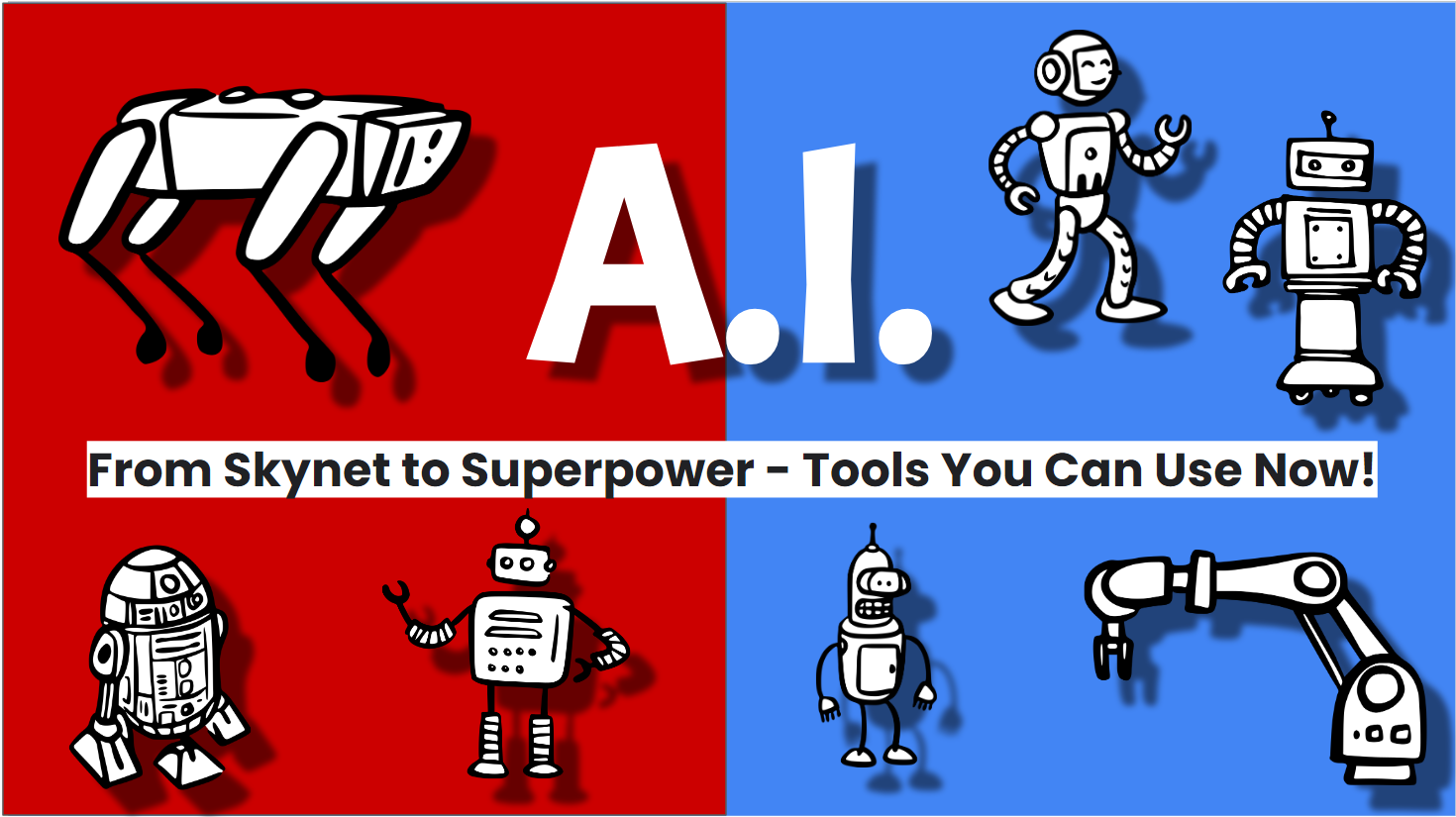
AI: From Skynet to Superpower; Tools you can use today

I was privileged to present this session for LISD teachers twice this summer. As I told them, I am not an AI expert but an enthusiast. It will be interesting to see how this will impact education. 

I showed these tools to be used as teacher tools and not necessarily for students use. Still a lot of fuzzy policies out there for students. 


This license lets others remix, adapt, and build upon your work non-commercially, and although their new works must also acknowledge you and be non-commercial, they don’t have to license their derivative works on the same terms.

Monday, April 15, 2024

A.I. presentation

 Working on a new (I guess more like updated) A.I. presentation for some summer classes. How does anyone keep up with this new stuff?!? So much to tell teachers and so little time. Keep looking at our social media for @LISDTechTips on Facebook, X(Twitter), Instagram, and Threads. 


This license lets others remix, adapt, and build upon your work non-commercially, and although their new works must also acknowledge you and be non-commercial, they don’t have to license their derivative works on the same terms.